The Everything-On-Chain Era:A RWA Spectrum Report





Introduction
The financial system is on the cusp of its biggest redesign in decades: real-world assets (RWA) are being rebuilt onchain. By bringing instruments such as U.S. Treasuries, corporate bonds, commodities, private credit, and real estate onto blockchain rails, RWAs unlock fractional ownership, 24/7 transferability, programmability and composability — capabilities that traditional financial infrastructure cannot match. These features address long-standing inefficiencies in capital markets, making RWAs one of the strongest candidates for large-scale blockchain adoption.
If stablecoins demonstrated how digital assets can operate at scale, RWAs extend that logic to the very foundation of financial markets. What began as small pilot programs has quickly accelerated into a structural transformation, fueled by investor demand for yield, institutional engagement, and maturing DeFi infrastructure. The era of “everything-onchain” is no longer a distant vision; it is underway, with RWAs positioned to become the cornerstone of the next financial epoch.
Co-authors

Strategic partners


Key Takeaways
01.
Excluding stablecoins, the tokenized real-world asset (RWA) market surpassed $36 billion in supply, growing 1.6x compared to 2024 and 1000x compared to 2019. Fixed-income products dominated while tokenized stocks skyrockted 106 times year-over-year.
02.
BUIDL by BlackRock and Securitize led institution-issued RWAs with $2.85 billion in supply and 34% market share of all tokenized U.S. Treasuries. In the institutional funds category, JAAA, a tokenized version of Janus Henderson’s Anemoy AAA CLO Fund issued via Centrifuge, exceeded $1 billion in market cap.
03.
Chainlink Runtime Environment (CRE) emerged as an all-in-one orchestration layer for institutional smart contracts with adoption from Swift, Euroclear, UBS, Mastercard, and more. In May, Chainlink collaborated with Ondo and J.P. Morgan’s Kinexys to complete the first successful settlement of OUSG on the Ondo Chain testnet.
04.
R3, which secures $17 billion in tokenized assets for institutional clients, expanded in May 2025 through its strategic collaboration with Solana, enabling regulated institutions to issue and settle RWAs directly on public blockchain infrastructure.
05.
On the retail side, Aave’s Horizon RWA Market enabled borrowing against assets such as Centrifuge’s JSTRY and JAAA, Superstate’s USTB and USCC, and VanEck’s VBILL, with market size growing 12x from $48.14 million at launch to $571.60 million in just three months.
06.
Backed by fixed-rate institutional loans, Maple Finance’s syrupUSDC grew rapidly, with total AUM rising from $162 million to $4.37 billion in 2025. Total deposits reached $630 million across Spark and Morpho on Ethereum, while syrupUSDC supply on Solana’s Kamino approached $106.41 million.
07.
Tokenized equities launched in August and September 2025 with significant traction, reaching $225.04 million in market cap on Ethereum and $199.58 million on Solana. Weekend trading volumes decreased when traditional equity markets closed, but on-chain price discovery continued.
08.
Regulators across major financial hubs are aligning tokenization with existing rules, including the SEC in the United States, MiFID II and MiCA in the European Union, and MAS in Singapore. In regions without regulatory clarity, gaps and the need to close them are becoming increasingly visible.
What Experts Say








The Overview:
Major Room for RWA Growth
Fixed-income products dominated
Excluding stablecoins, the tokenized real-world asset (RWA) market surpassed $36 billion in supply as of November 30, 2025, more than doubling from $15.75 billion at the start of the year. Compared to 2019, when tokenized asset value stood at just $33.21 million, this represents a staggering 1000x increase. Growth momentum has accelerated sharply over the past three years: year-over-year expansion rose from 60.79% in 2023, to 66.70% in 2024, and then to 159.29% in 2025.
According to a 2024 survey by the Official Monetary and Financial Institutions Forum (OMFIF) of 26 financial institutions, 65% said bonds were the asset class most likely to be tokenized. In practice, fixed-income products already dominated the tokenization landscape, with private credit accounting for $18.64 billion and tokenized U.S. Treasuries contributing $9.15 billion. This concentration reflects investor appetite for debt instruments, which combine attractive yields with relatively low risk compared to more volatile asset classes.
Tokenized stocks skyrocketed
Tokenized equities have emerged as the fastest-growing RWA category, with supply skyrocketing 106-fold from $5.93 million in October 2024 to $629 million in November 2025. Much of this growth came from Securitize’s Exodus Movement, which added over $300 million on Arbitrum and Algorand. Meanwhile, in Q2 2025, Backed Finance launched their tokenized U.S. equity product xStocks, which has since reached $150 million. Then, launching in Q3 with 100+ tokenized stocks and ETFs, Ondo Global Markets quickly surpassed the $100 million milestone as the fastest growing tokenized stocks platform, and has since accumulated over $300 million in TVL.
On November 20, Caesar partnered with Centrifuge to bring its equities onchain, becoming the first crypto-native company to offer its own stock in tokenized form. The tokenized equities market is poised for even stronger growth as Nasdaq is now in talks with U.S. regulators to enable trading of tokenized securities.
Ethereum led in tokenized supply, Plume dominated in holder count
Unsurprisingly, Ethereum remained the frontrunner in tokenized asset supply, with total RWA value reaching $11.9 billion as of mid-November, thanks to its deep liquidity and established infrastructure. It also hosted the highest number of tokenized assets, totaling 477, followed by Polygon with 279 and Plume with 198.
However, in terms of holder count, Plume had overtaken Ethereum by a wide margin, boasting 280,639 holders, which is 2.2 times more than Ethereum’s 130,230. Solana ranked third, showing remarkable momentum with its holder base soaring from 9,468 at the end of June to 105,762 by end of November.
Major room for growth potential
Despite the explosive acceleration in recent years, the tokenized RWA market remained a drop in the ocean compared to traditional finance. According to Helius, as of 2024, only 0.0026% of tokenizable assets were currently represented onchain.
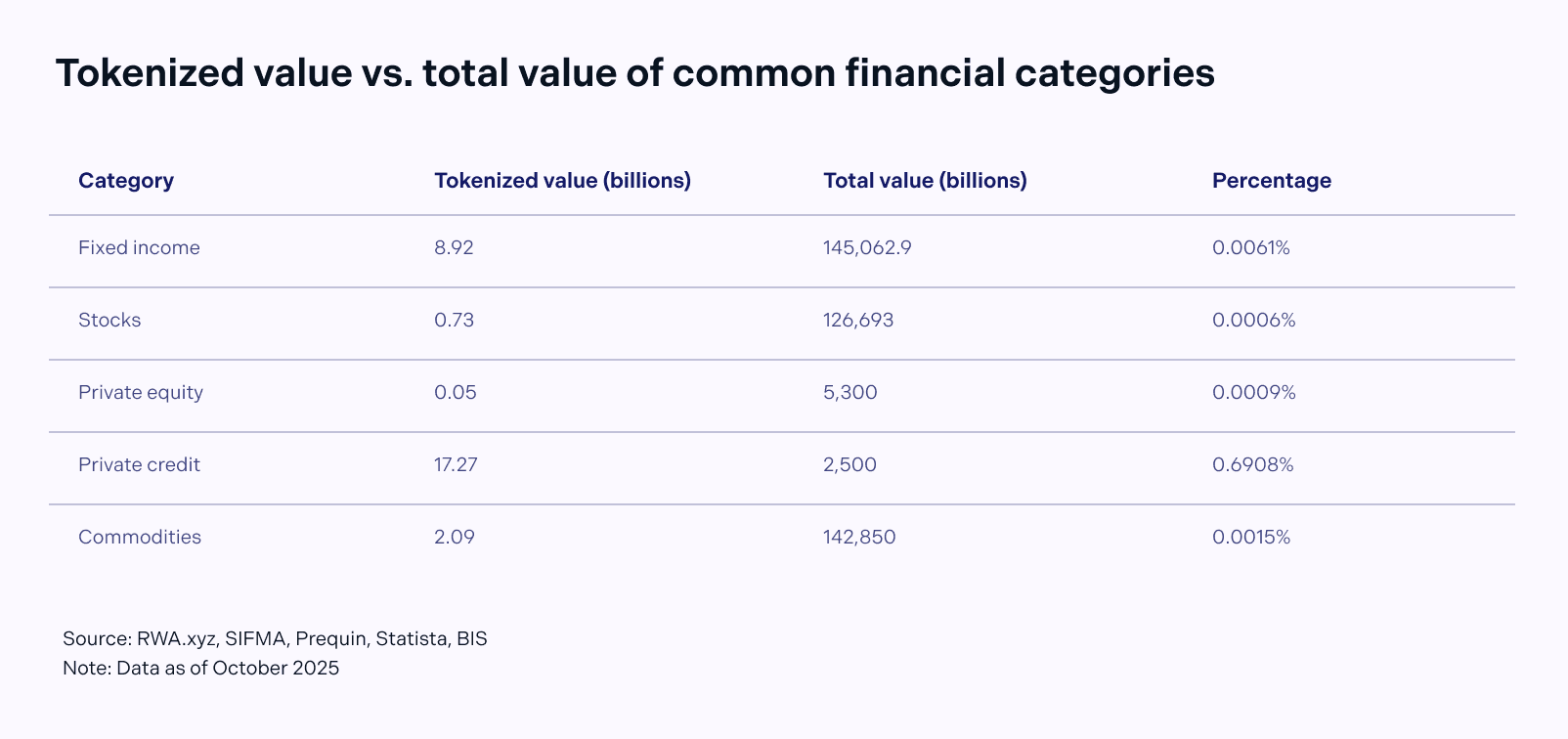
As shown in the table above, tokenized value was negligible across most categories — under 0.01% of total market size — with the exception of private credit, which led at 0.69%. This vast gap underscores how early the RWA sector still is, and how enormous the upside could be as tokenization expands.
For context, stablecoins followed a similar path: from 2020 to 2025, their share of the U.S. M2 money supply jumped from 0.15% to 1.11%, a nearly 70x increase in just five years. If RWAs grow along a comparable trajectory, the next decade could see unprecedented capital migration onchain. In fact, McKinsey projects total tokenized value to reach $1.9 trillion by 2030, representing a more than 60x increase from current levels.

The RWA Spectrum
Unlike crypto-native assets, real-world assets (RWAs) inherently contain offchain components tied to the physical or legal world. Every tokenized asset currently references an underlying offchain instrument, such as a bond, a security, or commodity, along with legal documentation defining ownership, transferability, and investor rights.
Traditionally, platforms have grouped RWAs into two models: onchain native, where investors transact entirely onchain, and hybrid, which records ownership onchain but relies on offchain infrastructure for investor interactions. As of October 2025, hybrid projects represented $16.36 billion, or 52% of total supply, according to RWA.xyz.
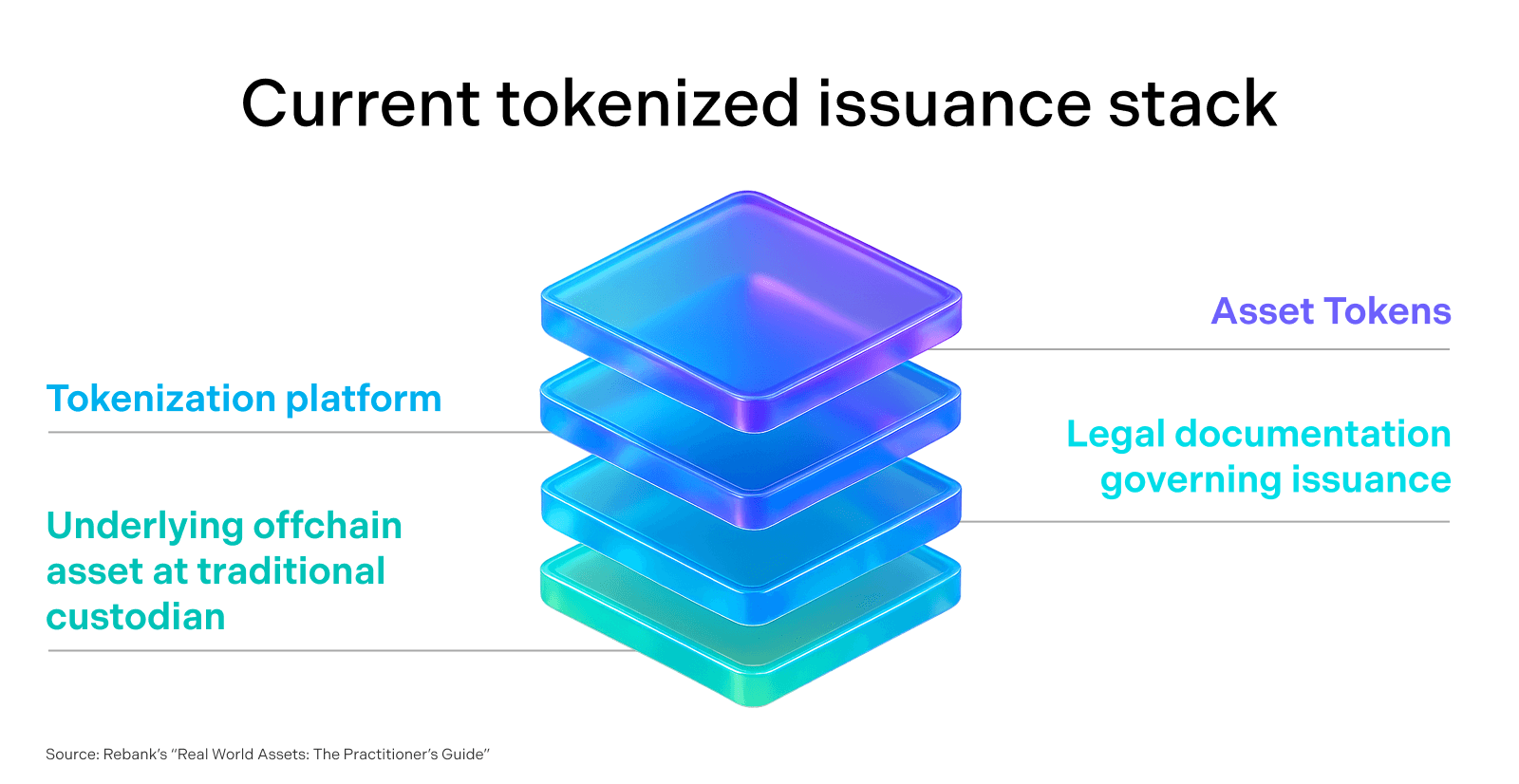
However, a binary classification oversimplifies reality. A more accurate view is to see RWAs on a spectrum that ranges from heavily regulated, institution-only assets on the permissioned end to permissionless, fully onchain tokens accessible to retail users. The closer an asset sits toward the permissioned end, the stricter its investor requirements such as KYB, accreditation, and high minimum investments. This results in smaller holder bases and minimal to no secondary trading.
It is important to note that permissioned does not necessarily equate offchain, as assets can be transferred fully onchain between whitelisted addresses. Examples include BUIDL, BlackRock’s tokenized U.S. Treasuries issued by Securitize, available only to qualified U.S. purchasers with a $5 million minimum and just 89 holders, and JAAA, Centrifuge’s tokenized Janus Henderson AAA CLO strategy, open to non-U.S. professional investors with a $500,000 minimum and only 10 holders. Both are permissioned but onchain native.
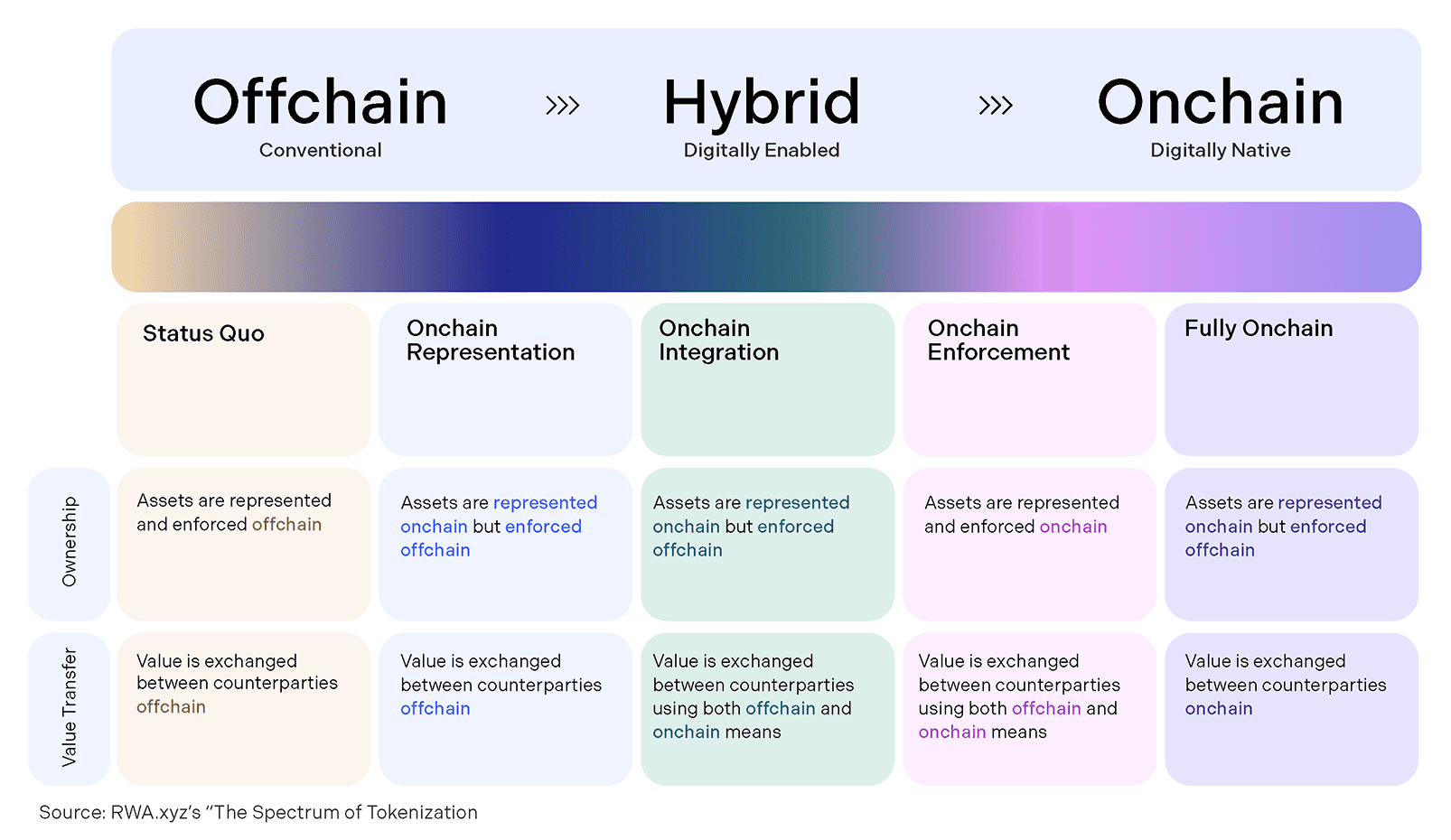
At the opposite end of the spectrum, retail-accessible RWAs require minimal KYC or none at all, leading to broader participation, DeFi integrations, and active secondary markets. A good example is xStocks by Backed Finance, a tokenized U.S. equity product on Solana with over 44,000 unique holders. Users can trade xStocks on CEXs or DEXs without additional KYC beyond platform requirements, and the token was integrated with Kamino Lending and Raydium from day one. Tokenized stocks and ETFs on Ondo Global Markets, available across Ethereum and BNB Chain, also follow the same model. Trading volume had reached over $699 million since September.
Driving RWA growth means recognizing that each driver — product design, institutional adoption, and regulation — exists along its own spectrum. The key lies in identifying where these elements converge to create the optimal balance between innovation, accessibility, and compliance. In the next sections, we continue this spectrum framework to explore how deeper institutional engagement, stronger retail product–market fit, and clearer regulatory foundations will define the next stage of RWA expansion.

Institutional Adoption
At the foundation of RWA growth lies institutional participation. Institutions are no longer experimenting; they are committing. Some remain within traditional frameworks, using blockchain for ownership records while maintaining offchain custody and compliance systems. Others are taking a more progressive stance, issuing assets directly onchain and developing infrastructure that connects existing banking networks with public blockchains. Together, these efforts form the structural backbone of the RWA ecosystem, ensuring that tokenized assets are not just technically possible but institutionally viable at scale.
Combining onchain record with offchain infrastructure
A more conservative approach is keeping offchain infrastructure while experimenting with onchain records, which can be seen with Figure and Tradable’s tokenized private credit products on Provenance and ZKSync respectively. This approach received criticism from DeFi natives, claiming that the tokenized assets have low holder count and no onchain activities, and that the projects are merely putting an internal database onchain while executing all processes offchain.
Although such criticism is not without foundation, this conservative choice is suitable for companies that want to experiment with blockchain and explore how to gradually integrate it into their existing stacks. Together, Figure and Tradable had tokenized $16 billion value of active loans by end of November 2025, approximating 85.24% of total onchain active loans value.
Issuing tokenized assets onchain
More recently, as regulations matured, institutions are starting to issue assets onchain. The institutional RWA landscape today is dominated by low-risk, fixed-income products such as U.S. Treasuries and institutional funds. Some institutions issue tokenized products directly, while others partner with tokenization service providers like Securitize or Centrifuge for issuance and compliance. The focus here is on assets managed or issued directly by traditional financial institutions, excluding service-led tokenization projects.
Leading the market was BUIDL, a tokenized money market fund managed by BlackRock and issued via Securitize, with supply surpassing $2.85 billion across seven networks as of mid-November. BUIDL held a commanding 34% market share of all tokenized U.S. Treasuries. It was followed by BENJI, self-issued by Franklin Templeton, with $850 million across eight networks, and WTGXX by WisdomTree, which had reached $620 million across seven networks. Other notable issuances include JTRSY (managed by Anemoy & Janus Henderson and issued via Centrifuge), FDIT (self-issued by Fidelity), and VBILL (managed by VanEck and issued via Securitize).
In the institutional funds category, JAAA, a tokenized version of Janus Henderson’s Anemoy AAA CLO Fund issued via Centrifuge, led with a market cap surpassing $1 billion as of October 2025. Around 75% of JAAA’s supply was minted on Ethereum, while its total market cap single-handedly accounted for roughly 30% of the entire institutional fund category. In September 2025, Centrifuge broadened its product lineup by partnering with Plume to introduce the Anemoy Tokenized Apollo Diversified Credit Fund (ACRDX), supported by a $50 million anchor investment from Grove, the credit infrastructure protocol in the Sky Ecosystem. Within this category, Securitize led in asset count with 14 tokenized funds; these assets together made up $861 million of onchain value.
An interesting case of deep institutional integration is WisdomTree, an asset management firm and leading provider of exchange-traded funds (ETFs) founded in 1985 in the U.S. In 2019, the firm launched its first Bitcoin exchange-traded product, marking its first and early entrance into crypto. Since then, WisdomTree has doubled down on RWA with 15 assets on multiple chains, totaling $650 million spanning money market, equities, fixed-income and asset allocation. Most recently, WisdomTree announced a partnership with BNY, a global financial services company, in which BNY would serve as WisdomTree’s core banking-as-a-service infrastructure provider to advance access to stablecoins and RWAs. They also recently partnered with Chainlink to bring NAV data onchain for their tokenized private credit fund (CRDT) via Chainlink DataLink.
Building infrastructure that bridges traditional finance
and decentralized finance
The deepest level of institutional engagement in RWAs lies in building infrastructure that connects traditional finance with decentralized systems, creating interoperability between legacy banking rails and blockchain networks. This integration brings the long-standing vision of onchain finance closer to reality.
Chainlink is one of the leading pioneers in this space, having recently launched the Chainlink Runtime Environment (CRE), an all-in-one orchestration layer for institutional smart contracts that enables cross-chain interoperability while maintaining compliance, privacy, and enterprise-grade security. CRE launched in November at SmartCon 2025, with some of the largest financial institutions in the world adopting it at launch, including Swift, Euroclear, UBS, Mastercard, and more. In May, Chainlink collaborated with Ondo and J.P. Morgan’s Kinexys to complete the first successful settlement of OUSG on the Ondo Chain testnet. CRE served as the secure orchestration layer linking J.P. Morgan’s permissioned Kinexys Digital Payments network to Ondo Chain — marking the first delivery-versus-payment settlement that connects traditional settlement rails to blockchain infrastructure.
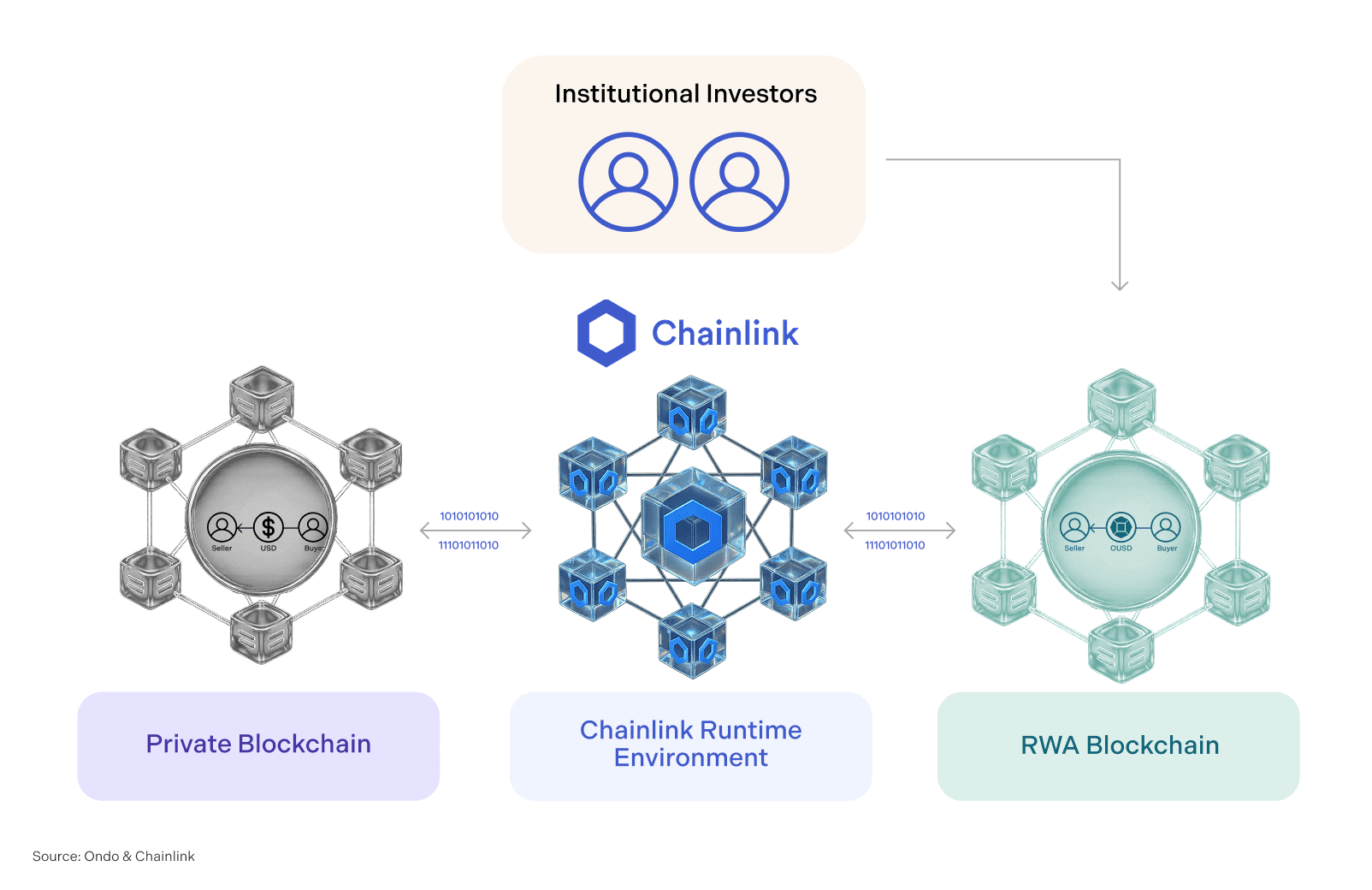
In September, Chainlink expanded upon this innovation by advancing tokenized fund workflows with Swift messaging in collaboration with UBS to develop a technical solution enabling institutions to manage digital asset workflows directly through existing Swift infrastructure. The initiative used ISO 20022 messages sent through Swift and CRE to trigger subscription and redemption workflows for UBS Tokenize, the bank’s in-house tokenization platform. CRE handled the Swift messages, executing the transactions via the Chainlink Digital Transfer Agent (DTA) technical standard.
This plug-and-play integration effectively abstracts away blockchain complexity, enabling institutions to interact with tokenized assets through familiar financial messaging — a breakthrough that could unlock access to the $100 trillion global fund industry. In November, UBS Tokenize and DigiFT announced the completion of the first-ever redemption of a tokenized fund using the Chainlink DTA technical standard, powered by CRE.
Another milestone example is R3's strategic collaboration with Solana. R3 is a world leader in real-world asset (RWA) tokenization and interoperability solutions, driving market digitization and bridging the largest onchain RWA ecosystem with DeFi. R3 supports tens of millions of monthly transactions and secures $17 billion in tokenized assets across its platforms for clients such as Euroclear, HQLAx, and the Swiss Digital Exchange (SDX). The R3–Solana collaboration marks a major step in connecting permissioned ledgers with a high-performance public blockchain. By connecting real-world asset issuers with onchain capital allocators on Solana, R3 is streamlining the process of bringing regulated institutional assets onchain and unlocking new opportunities for revenue generation through new yield opportunities and collateral backed by the high-quality real-world assets of the R3 ecosystem.

Retail Product-Market Fit
Continuing with the spectrum framework, retail accessibility sits on one end of the RWA expansion curve. While institutional RWAs remain restricted by high entry thresholds and compliance requirements, developers are innovating on new ways to bridge that divide — transforming institutional-grade assets into permissionless, DeFi-native instruments. From treasury-backed stablecoins like USDtb and frxUSD to yield-bearing tokens such as syrupUSDC and wrappers like tokenized equities, these models extend the reach of RWAs beyond accredited investors. In doing so, they bring traditional financial value directly onchain, signaling a critical step toward broader inclusion and a fully composable onchain economy.
RWAs as collateral for DeFi-composable stablecoins
Since not all RWAs are accessible to retail investors, some projects are using institutional-grade RWAs as collateral to create retail-accessible assets such as stablecoins. For instance, since BUIDL is limited to qualified institutions with a $5 million minimum investment, Ethena launched USDtb to be backed by BUIDL and fully composable across DeFi protocols.
By mid-October 2025, USDtb had reached a $1.28 billion market cap on Ethereum, with its USDtb–USDC pool on Curve Finance holding $20 million in liquidity and averaging $2.26 million in daily trading volume. Retail users can earn yields by supplying USDtb to lending markets or borrowing USDtb against popular assets to use in DeFi protocols. Thanks to the USDtb reward program by Merkl, users can earn on average 6.83% supply APY across Aave, Morpho, Fluid and Euler. Lending activity was concentrated on Aave, which held $101.89 million supplied and $59.45 million borrowed, far exceeding other protocols.
Another example is frxUSD, a stablecoin fully backed by tokenized U.S. Treasuries. Its $75.43 million reserve consisted of 71.65% USTB, 20.34% BUIDL, and 4.11% WTGXX. While USTB and BUIDL are restricted to accredited investors with minimum investments of $100,000 and $5 million respectively, WTGXX is available to U.S. retail and institutional investors with a $1 minimum.
frxUSD is a yield-bearing stablecoin that earns 3.85% from underlying treasury yields by default, or 5.60% when staked for sfrxUSD. As of November 2025, frxUSD had a $98.36 million market cap, $21.9 million in liquidity, and $3.31 million in daily trading volume on Ethereum. The number of frxUSD holders rose from fewer than 10 in February to 729 by October, while sfrxUSD holders reached 309, with total yield paid out surpassing $1.33 million and total supply nearing $43.22 million. The 2x surge in frxUSD supply in October 25 after the pre-deposit campaign with Stable translated into the surge in frxUSD holder count and liquidity, as well as in sfrxUSD holder count a few days after.
In lending, Aave’s Horizon RWA Market enables users to deposit tokenized real-world collateral and borrow stablecoins against it. Launched on Ethereum on August 27, 2025, Horizon quickly became the fastest-growing RWA lending venue, expanding its total market size 12x from $48.14 million at launch to $571.60 million within just three months.
Permissioned users approved by RWA issuers can supply assets such as Centrifuge’s JSTRY and JAAA, Superstate’s USTB and USCC, VanEck’s VBILL, and Circle’s USYC. As of late November 2025, JSTRY led with $30.66 million supplied, followed by USYC at $20.48 million and VBILL at $9.17 million. JSTRY also posted the strongest growth, rising 15x from $2.08 million at launch.
RWAs repackaged into permissionless yield-bearing tokens
Beyond low-risk treasury products, projects are now making traditionally institutional-only instruments such as public and private credit accessible onchain. A notable example is syrupUSDC by Maple Finance. Acting as a credit marketplace, Maple allows institutions to lend BTC, ETH, and other major tokens into high-yield, overcollateralized lending pools for institutional borrowers. These borrowers then utilize these loans to grow their real-world businesses, making the ecosystem a combination of onchain asset management and real-world utilization. To open participation to permissionless retail users, Maple introduced syrupUSDC — a liquid yield-bearing token offering 6.5% base APY (excluding rewards) sourced from fixed-rate institutional loans.
The launch of syrupUSDC on Ethereum and its subsequent expansion to Solana fueled Maple’s rapid growth. Since early 2025, total assets under management have surged from $162 million to $4.37 billion, with an all-time high of over $5 billion. By November 2025, syrupUSDC’s market cap surpassed $1.39 billion, with 99.71% concentrated on Ethereum and the remainder on Solana and Arbitrum. The token has become deeply integrated into DeFi, with total deposits reaching $630 million across Spark and Morpho, representing 97.4% of all syrupUSDC utilized in DeFi on Ethereum. On Solana, syrupUSDC supply on Kamino approached $106.41 million, roughly 37% of the chain’s total syrupUSDC market cap.
On decentralized exchanges, syrupUSDC liquidity on Solana reached $39.13 million, double that of Ethereum’s $19.86 million. Average daily trading volume was 10 times higher on Solana at $9.83 million, compared to $972k on Ethereum. Most trading activity occurred on each network’s leading DEX, namely Uniswap V4 on Ethereum and Orca on Solana.
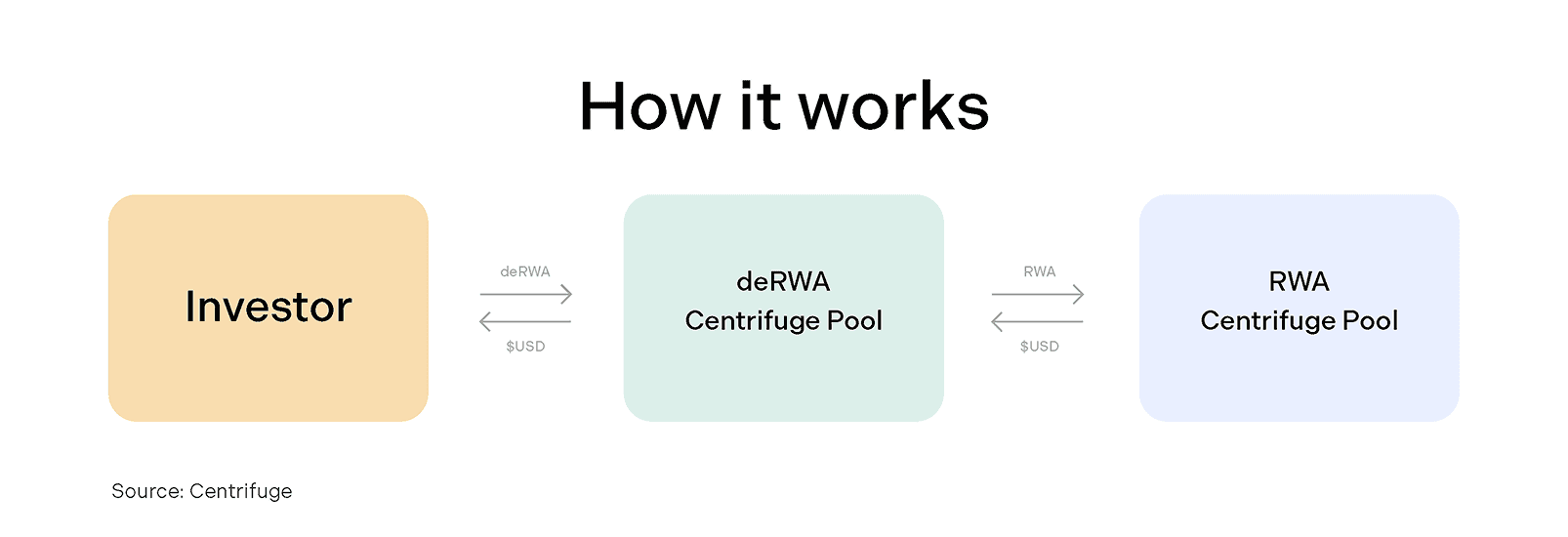
A more recently launched product is Centrifuge’s deJAAA, the semi-permissioned and DeFi-friendly version of the tokenized Janus Henderson Anemoy AAA CLO Fund. In practice, Centrifuge offers a wrapping service for issuers looking to bring their RWA to a broader user base through DeFi integrations. Deployed on both Solana and Base, deJAAA total value locked cross-chain has surpassed $10 million.
RWA wrapped into speculative assets
The third major pathway for expanding retail participation in RWAs is through tokenized accessible assets. The launch of tokenized equities in August and September 2025 marked a major milestone for the industry. For the first time, retail users can gain onchain exposure to U.S. stocks without completing KYC verification, enabled by wrapping services from projects such as Ondo and Backed Finance. Holder counts for these assets quickly climbed into the thousands.
While tokenized equities do not represent legal ownership of the underlying shares, they do offer an accessible means for users to gain economic exposure to the underlying stocks. An examination of Tesla stock TSLA and its onchain tokenized version TSLAx by Backed Finance on Solana shows that the prices tokenized stocks closely followed their real counterpart. Daily price deviation fluctuated within a small range of -5.02% and 3.45%.
On Solana, the total market capitalization of tokenized equities reached $199.58 million by early December 2025, including xStocks, PreStocks, and rStocks. Tesla xStock (TSLAx) led with $42.06 million in market cap, more than double NVIDIAx at $22.55 million, following a 26% price rally in September. Daily trading volume averaged $4.33 million, peaking at $11.81 million on October 10, with a pronounced concentration on TSLAx at an average of 35.81% total trading volume per day. Volumes dropped noticeably on weekends when traditional equity markets were closed, yet price discovery still happened onchain.
Such weekend slowdowns were also seen on Ethereum, where trading volume fell as low as $50.49 on September 14. This is due to the difference in xStocks and Ondo Global Markets model: while xStocks has onchain liquidity and are available 24/7, Ondo Global Markets tap into the liquidity of traditional equity markets with 24/5 mints and redemptions. Total market capitalization on Ethereum was 12.76% larger than on Solana ($225.04 million versus $199.58 million), yet overall trading activity declined sharply from a monthly average of $10.76 million in September to just $1.26 million in October, before going on an upward trend again in November.
Besides tokenized equities, commodities such as tokenized gold are also popular among retail users. Two major representatives are XAUt by Tether and PAXG by Paxos. Though both launched early in 2019-2020, it wasn’t until September 2025 that trading volume skyrocketed, partly due to gold’s impressive price surge to over $4,400. Despite having much lower market cap, PAXG has four times more holders than XAUt and twice as much liquidity.

Regulatory Clarity
The regulatory landscape for tokenized real-world assets (RWAs) is evolving rapidly as governments and financial authorities recognize their potential to modernize capital markets. While some jurisdictions have already established clear legal frameworks that integrate RWAs into existing financial systems, others are still catching up. The resulting disparity is shaping where innovation happens and how fast institutions can scale their tokenization strategies.
Established jurisdictions are fitting RWAs into existing legal and financial structures
Across leading financial hubs, regulators are aligning RWA oversight with existing laws. In the U.S., all participating agents are regulated under the Securities and Exchange Commission (SEC). In early October 2025, Plume acquired SEC’s license as a registered transfer agent.
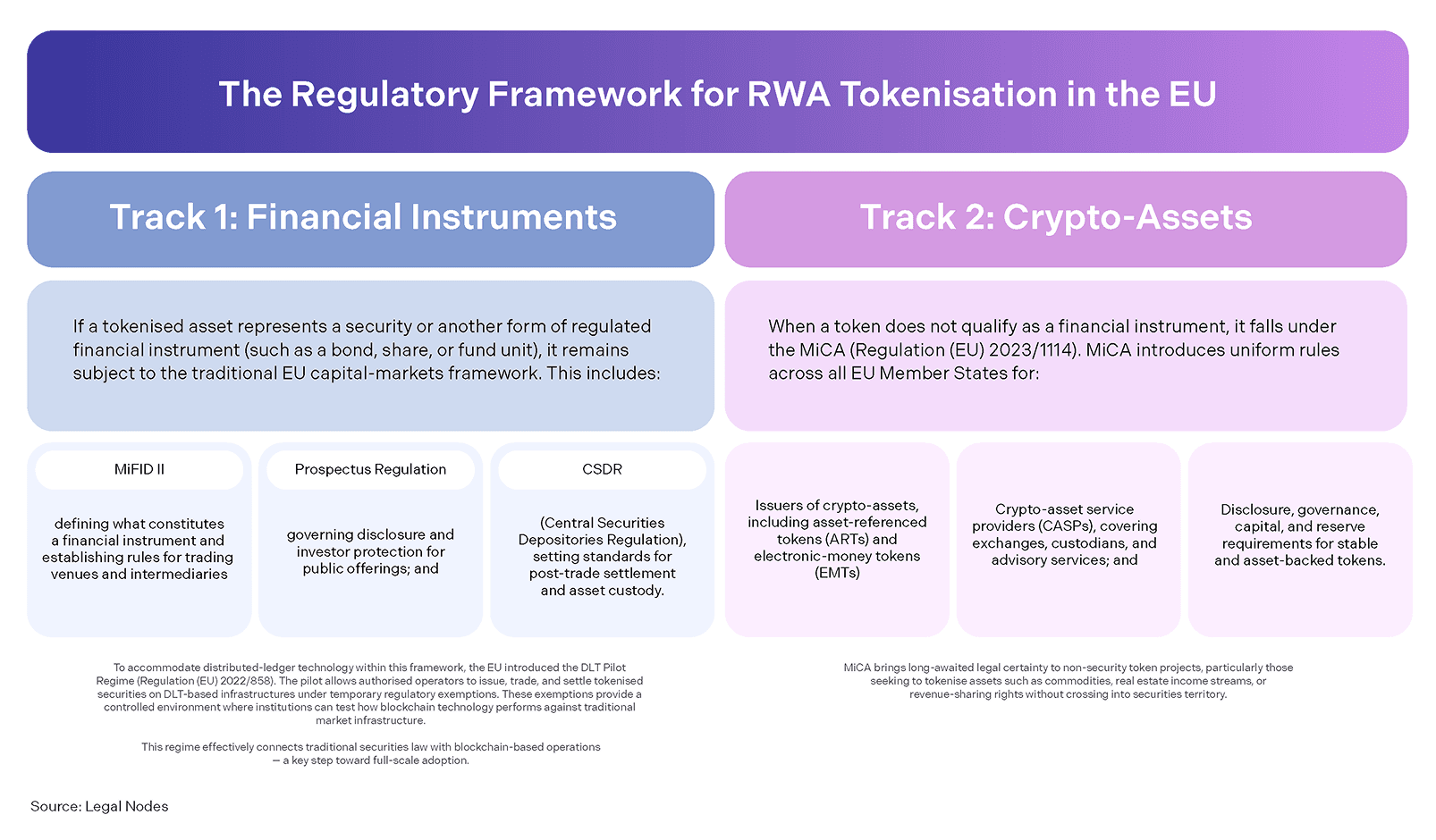
In the European Union, the legal framework now follows two distinct tracks: the financial instruments track that applies when tokens represent regulated instruments such as bonds, funds, or equities, including MiFID II, Prospectus Regulation, and CSCR, and the crypto-assets track which covers tokens that do not qualify as securities and are regulated under MiCA.
Other jurisdictions are taking similar approaches. Switzerland’s FINMA, Singapore’s MAS, and the UAE’s VARA have all introduced tokenization-friendly regulations under the principle of “same activity, same risk, same regulation.” These frameworks give institutions confidence to tokenize assets while staying compliant. In Singapore, Project Guardian — a collaborative initiative led by the Monetary Authority of Singapore (MAS) that unites key financial institutions and technology partners through multiple pilot programs — has demonstrated how tokenized bonds and funds can operate effectively and securely within a regulated framework.
Increasing pressure on regulators
In regions still lacking clarity, the gap is becoming more visible, and so is the urgency to close it. Without established rules, investors remain vulnerable to fraud and market uncertainty, while innovators move operations to more progressive jurisdictions. Policymakers now face a difficult balance: protecting consumers while ensuring their economies benefit from blockchain-driven financial modernization.
The United States provides a useful example. While comprehensive RWA regulation has yet to emerge, lawmakers have passed stablecoin-specific frameworks such as the GENIUS Act to secure consumer protection and preserve the global role of the U.S. dollar. This illustrates a broader goal: using blockchain not only to foster innovation but also to reinforce financial influence on a global scale. Similarly, other markets are realizing that timely regulation is not just about compliance — it is a competitive advantage that determines who will lead in the era of tokenized capital markets.
Conclusion
The tokenization of real-world assets marks a defining shift in the evolution of global finance. In just a few years, RWAs have transformed from experimental concepts to credible, institutional-grade instruments connecting traditional markets with decentralized infrastructure. The market’s rapid expansion — driven by loan-based products, tokenized treasuries, and newly emerging tokenized equities — shows that blockchain technology is no longer an abstract innovation but a foundation for more efficient, transparent, and inclusive financial systems.
Yet, what we see today is only the beginning. The share of tokenized assets remains a fraction of their total addressable market, signaling vast room for growth. To unlock this potential, three forces must converge: scalable retail product–market fit, deeper institutional integration, and a harmonized regulatory framework that provides clarity without stifling innovation.
As the stablecoin era has already proven, once tokenized systems achieve trust, utility, and regulatory legitimacy, adoption can accelerate exponentially. RWAs are now entering that same inflection point — moving from proof of concept to global infrastructure. The next phase will not just digitize financial assets; it will redefine how ownership, yield, and liquidity operate across borders, ushering in what can truly be called the “everything-onchain” era.
Special thanks
We would like to express our sincere gratitude to partners and friends
who have supported us and provided data so that we can complete this report.
Co-authors

Strategic partners


Data providers